

Your life insurance has a down payment
Although it is now known that rescue parachute deployments usually have a mild outcome, there are repeated reports of accidents caused by the emergency parachute being deployed too late or not at all. Deploying the reserve parachute is not part of the repertoire of many pilots. In the extremely stressful situation of a crash, it is simply forgotten, or the fear of a rescue parachute being deployed is too great.
Limited perception
Under severe stress, only action sequences that do not require cognitive (mental) abilities are generally used. Action will essentially be limited to processes that can be called up without thinking, i.e. that are automated.
A pilot who has practiced the necessary manoeuvres intensively and correctly is much more likely to be able to recall the correct action plan in an emergency. This also explains why particularly experienced competition, cross-country or acro pilots hardly feature in the accident statistics. They know when and how to react, the exit at the rescuer is anchored in their subconscious and body cells.
The untrained person lacks all of this. Those who only know what to do in theory have the problem that an extreme situation is the worst possible time to put their knowledge to the test in practice. This is because putting theory into practice is a process in which the head (the theoretical knowledge) constantly communicates with the body (the feelings). In dangerous situations, however, the mind has largely shut down at times and is no longer available with any significant capacity. This often leads to the pilot being guided only by his instincts. Instinct-driven actions, which are not based on knowledge and experience, are problem-focused and not solution-oriented. The rescue chute is triggered too late or not at all.
Contents
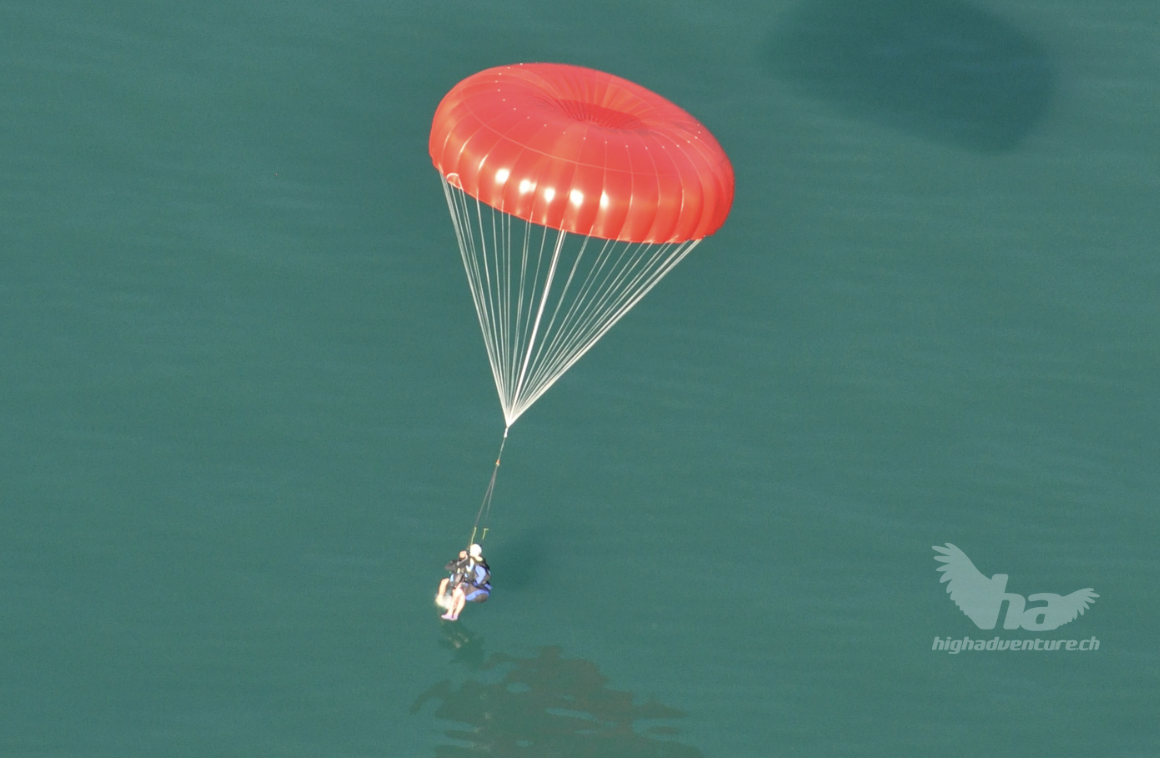
From getting to know your equipment and the correct way to use it when throwing to the correct behavior on the rescue system, you will prepare yourself for the worst-case scenario. You can be sure that your confidence in yourself and your equipment will be much higher after this course than before, no matter how much flying experience you have. The course begins the evening before with an equipment check (focusing on harness adjustment and rescue parachute deployment) and a detailed theoretical briefing. You will then release your rescuer one-to-one in the air. The training takes place under expert guidance above water.
We also prepare Beamer pilots for a controlled descent, even without disconnecting the paraglider.
Requirements and expectations
PILOT EXPERIENCE
25%
RESCUE PARACHUTE TRAINING
100%
Included
- Material check, K-test
- Harness adjustment
- Rescue parachute theory and application examples
- Course materials
- Professional support - benefit from our experience from over 400 rescue parachute deployments over ground
- Life jacket
- Terrain briefings
- Water rescue by boat
- Video recordings & transmissions with the revolutionary SmartStream
Not included
- Ascent
- Accommodation and meals
- Repacking the rescue package. On request, we can provide you with
- Repacking the rescue package. On request, we can provide you with a rescue device (Beamer 3 or PENTAGON) and/or a paraglider for landing in the water for a fee.
Instructor
- Urs Haari
Information
The weather decision will be made the evening before the course starts. In the event of bad weather, the course will be rescheduled for a different date. If you have to cancel the training for other reasons, the cancellation conditions according to our GTC apply.
-
Dates: *September 5 & 6, 2026—Saturday starting at 5 p.m., Sunday from 8 a.m. to approximately 3 p.m.
*Alternative date in case of bad weather: September 04 & 05 Friday from 6 pm, Saturday 8 am to approx. 3 pm.
Please only register if both dates are possible. - Location: Previous day: Dallenwil / Rescue throw: Beckenried
- Price: CHF 190
Rent & test a Beamer
Would you like to try out the market-leading emergency parachute in a controlled environment?